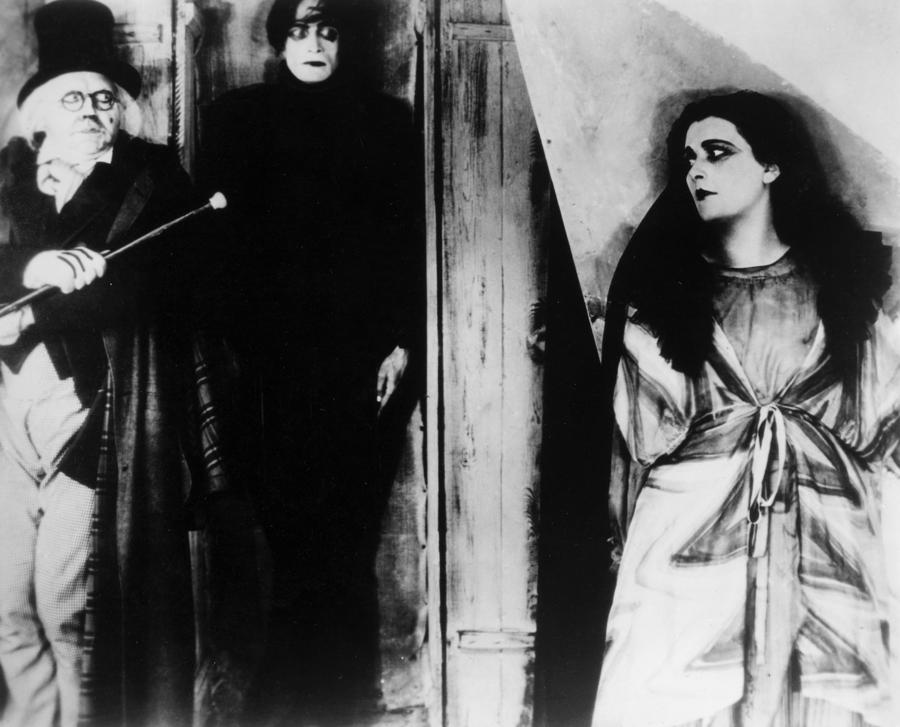
The Cabinet of Dr. Caligari and His Somnambulist Cesare
Watching “The Cabinet of Dr. Caligari,” a silent film masterpiece, I found myself deeply engrossed in its visual storytelling. Without spoken dialogue, the film relied heavily on facial expressions and set design to convey its eerie narrative. The haunting soundtrack further amplified the emotions and tension, making each scene more impactful.
One of the most striking aspects was the editing, which masterfully drew the audience into Dr. Caligari’s twisted psyche. In a particularly memorable sequence, the camera repeatedly cut to Dr. Caligari’s face after Cesare foretold someone’s impending doom to a horrified crowd. This technique not only heightened the suspense but also provided a chilling insight into Caligari’s disturbed mind.
A seemingly innocuous detail—a small, old, grey-haired man waiting to apply for a permit at the fair—was used to subvert expectations. The filmmakers cleverly played on the assumption that a doctor, especially one of such benign appearance, could not possibly harbor malevolent intentions. This made the revelation of Dr. Caligari’s true nature all the more shocking.
For its time and limited production resources, the film’s set design and art direction were remarkable. Sharp, jagged angles symbolized the villain, while rounder, softer shapes represented the naive heroine, whose fate was tragically sealed by her gullibility. The entire movie was shot on a stage, yet it convincingly transported the audience through various settings. I even noticed a clever reuse of a painted room in different scenes, showcasing the filmmakers’ ingenuity.
One particularly menacing visual choice was Dr. Caligari’s white gloves with painted fingers. In a scene where he lures the heroine into his tent to see Cesare, the stark contrast of his white hand against the dark tent entrance created a foreboding image, hinting at her inevitable doom. This meticulous attention to detail added layers of menace to the character.
The camera work was equally innovative. Before ending a scene, the camera shutter would close in on a character’s face, capturing their expression. It would then partially open to reveal another character in the next scene, seamlessly guiding the audience from one moment to the next.
“The Cabinet of Dr. Caligari” is a testament to the power of visual storytelling. Its use of set design, editing, and camera work created an immersive experience that, despite its silence, spoke volumes.
Discover more from Decentralized Intelligence
Subscribe to get the latest posts sent to your email.
 Decentralized Intelligence